




A cement plant reported that after prolonged operation since its commissioning, the contact width between the kiln tyre and support rollers was only 60% of the tyre width. Technically, can the kiln continue to operate under such conditions? To address this question, we consulted Engineer Mr. Zhang, a seasoned expert in the field.
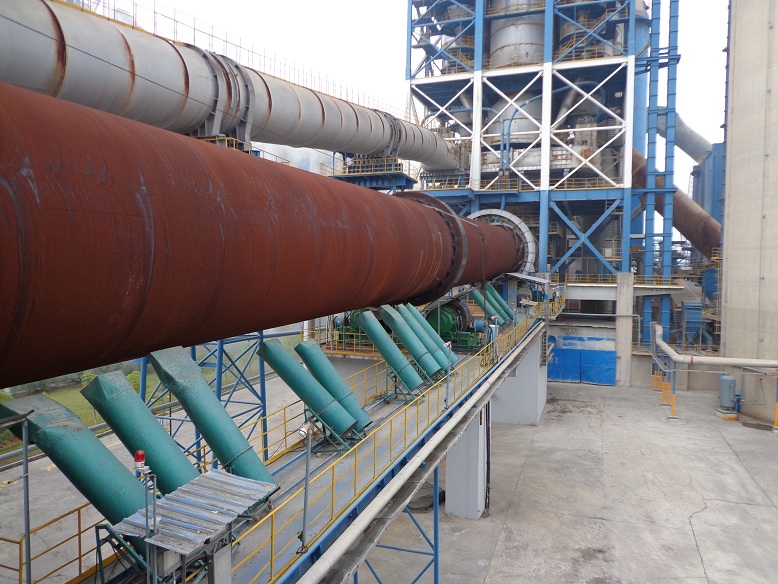
Engineer Mr. Zhang explained that there are two installation scenarios for rotary kiln tyres and support rollers:
1. Large precalciner kilns with hydraulic thrust rollers
In this configuration, the axes of the tyre and support rollers must be parallel to each other. The kiln shell is pushed upward by the hydraulic system and moves downward due to its own weight. Therefore, the required contact length between the tyre and support roller should be 100% of the tyre width.
2. Rotary kilns without hydraulic thrust rollers
For kilns without hydraulic thrust rollers, an upward movement of the kiln shell is achieved by maintaining a certain angle between the roller axis and the kiln axis. As a result, the required contact width can be reduced, but shall not be less than 70% of the tyre width.
In practice, the contact width between support rollers and tyres often falls below 50% over the long term, due to factors such as:
-
Oversized roller width in the original design,
-
Improper axial movement of the kiln shell, leading to stepped wear on the roller cross-section,
-
Prolonged non-parallelism between the roller axis and the kiln axis, causing uneven wear on both surfaces.
Such insufficient contact width eventually damages both the support rollers and the tyres.
Recommendation:
Maintenance personnel must pay close attention to changes in contact length during routine inspections. Adjustments using the hydraulic thrust roller system should be made to ensure that the contact length is never less than 70% of the tyre width.